Showing posts with label Health and Science. Show all posts

Friday, February 10, 2017

Autism: Brain Stem & Aggression Connection Really Hit Home for This Mom!!!

I just read about new research connecting the size of an individuals brain stem to autism-related aggression. This could explain why after years of behavioral therapy we have massively reduced Nick's aggression, but it's NOT gone. 

I'm always trying to explain to people who interact act with Nick that you have to help Nick be proactive in deescalating himself, because once he gets upset it's only going to escalate, and it could take minutes, hours or even days for him to come back to baseline. This connection speaks to so much in Nicholas. I'm like "Wow".


I'm sending this to his neurologist right now. You may want to do the same.

New research from BYU's autism experts is providing clues into the link between aggression and autism -- clues the team hopes will eventually lead to more effective intervention.  
In the study, published in Research in Autism Spectrum Disorders, researchers report an inverse correlation between aggression and brain stem volume in children with autism: the smaller the brain stem, the greater the likelihood of aggression.
The finding, though preliminary, is significant in part because "the brain stem is really involved in autonomic activities -- breathing, heart rate, staying awake -- so this is evidence that there's something core and basic, this connection between aggression and autism," said coauthor and BYU clinical psychology Ph.D. student Kevin Stephenson.
For the project, the team examined MRI images from two groups of children with autism: one that exhibited problematic levels of aggression and one that didn't. Study coauthor Terisa Gabrielsen, a BYU assistant professor of school psychology, said identifying the brain stem as having at least a partial involvement in aggression helps lay a foundation for better treatment. "If we know what part of the brain is different and what function that part of the brain controls, that can give us some clues into what we can do in the way of intervention," she said.
Coauthor and BYU psychology professor Mikle South added, "Once the body arousal in a child is too much -- the heart is beating, the hands are clenched and the body is sweating -- it's too late. Some of these kids, if the brain isn't working as efficiently, they may pass that point of no return sooner. So with behavioral interventions, we try to find out what the trigger is and intervene early before that arousal becomes too much."
BYU's Autism Connect team originated three years ago in BYU's David O. McKay School of Education, though it now includes researchers from other colleges on campus and collaborators beyond BYU. This paper, spearheaded by BYU psychology assistant professor Rebecca Lundwall, had 11 authors from BYU, one from the University of Utah and one from the University of Wisconsin-Madison. The group used data collected from a University of Utah autism study funded by the National Institutes of Health.
Studying aggression is Autism Connect's "overarching agenda," said Gabrielsen, "because it impacts families' quality of life so significantly. If we look long-term at things that affect the family the most, aggression is one of the most disruptive."
South recounted a conversation with the mother of a child he recently diagnosed: to cope with stress, the child often pulled her mother's hair, "so I just have a lot less hair than I used to," she told him. Aggression, South noted, "makes the family dynamic very difficult, the school dynamic very difficult. It's just a particularly difficult type of autism."
In addition to a number of other studies planned or in process, the team is interested in exploring further how the brain stem is connected functionally to other areas of the brain, "because usually the brain doesn't work from just one area; it's a network of areas that all work together," Stephenson said. "So if one area is disrupted, it's likely that other areas are disrupted as well."

Story Source:
Materials provided by Brigham Young University. Note: Content may be edited for style and length.

Journal Reference:
  1. Rebecca A. Lundwall, Kevin G. Stephenson, E. Shannon Neeley-Tass, Jonathan C. Cox, Mikle South, Erin D. Bigler, Emily Anderberg, Molly D. Prigge, Blake D. Hansen, Janet E. Lainhart, Ryan O. Kellems, Jo Ann Petrie, Terisa P. Gabrielsen. Relationship between brain stem volume and aggression in children diagnosed with autism spectrum disorder. Research in Autism Spectrum Disorders, 2017; 34: 44 DOI: 10.1016/j.rasd.2016.12.001

Thursday, February 26, 2015

News: Autism Genes Active During Fetal Development

Genes Connected to Autism Active During Fetal Development

February 22, 2015 | by Lisa Winter
photo credit: vetre/Shutterstock
Autism Spectrum Disorder (ASD) affects about 1 in 68 children. Genetics plays a large role in the onset of ASD, but the exact genes involved are not clearly defined. However, a new paper published in Neuron describes how specific genes known to be connected to ASD are active during fetal brain development. Lilia Iakoucheva of the University of California, San Diego headed up the research.
The study focused on copy number variants (CNVs) in particular regions that have previously been connected to ASD. However, the researchers soon learned that not all CNVs were activated during the same growth period. Activation of various CNVs was staggered throughout fetal development. 
The two genes, known as KCTD13 and CUL3, have ASD-associated mutations, and become activated around the middle of development. These genes regulate the protein RhoA, which is crucial to brain development. RhoA is responsible for the development and maintenance of neurons, while also assisting in the regulation of their migration.
"The most exciting moment for us was when we realized that the proteins encoded by these genes form a complex that regulates the levels of a third protein, RhoA," Iakoucheva said in a press release. "Suddenly, everything came together and made sense.”
Image credit: UC San Diego School of Medicine
“Our model fits perfectly with what we observe in the patients," co-first author Guan Ning Lin added.
Using zebrafish (a common model organism in genetics), they found that certain mutations on CUL3 adversely affected KCTD13, which, in turn, affected the normal function of RhoA. Just as the zebrafish with these mutations had head sizes that differed from typical development, so do children with ASD. Additionally, the mutations also correlated to the weight of the fish, just as it does in humans.
Moving forward, it is hoped that obtaining a better understanding of these genetic pathways and how they connect to various disorders on the Autism spectrum will allow researhers to manipulate these pathways into a potential treatment.
"The fact that three different types of mutations may act via the same pathway is remarkable," concluded Iakoucheva. "My hope is that we would be able to target it therapeutically. If we can discover the precise mechanism and develop targeted treatments for a handful of children, or even for a single child with autism, I would be happy.”

Monday, December 29, 2014

Half Of All U.S. Children Will Be Autistic By 2025 - MIT Researcher’s New Warning

MIT Researcher’s New Warning: At Today’s Rate, Half Of All U.S. Children Will Be Autistic By 2025


Research scientist Stephanie Seneff of the Massachusetts Institute of Technology (MIT), a widely published author on topics ranging from Azlheimer’s Disease to autism and cardiovascular disease, raised plenty of eyebrows recently with a bold proclamation on autism at a special panel in Massachusetts about genetically modified organisms and other topics.
“At today’s rate, by 2025, one in two children will be autistic,”  Seneff said last Thursday in Groton, MA at an event sponsored by the holistic-focused Groton Wellness organization.  
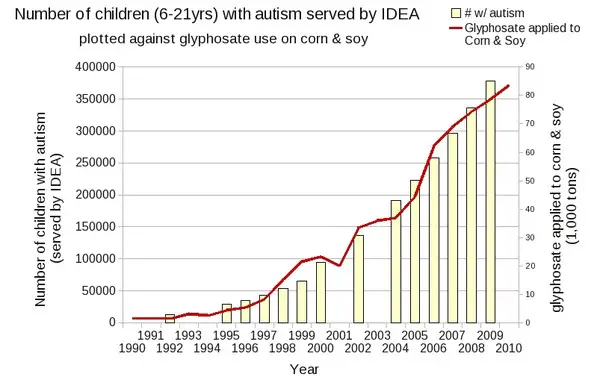
Seneff presented slides showing a remarkably consistent correlation between the rising use of Roundup (with its active ingredient glyphosate) on crops and the rising rates of autism; while it doesn’t show a direct correlation it does give researchers plenty to think about, especially considering Seneff’s research into the side effects of autism that mimic glyphosate toxicity and deficiencies.
gloysphate
The slide notes that the heaviest use of Roundup, Monsanto’s flagship weedkiller, began in 1990 and continued to rise since. Meanwhile, the  number of kids with autism has gone from 1 in 5,000 in 1975 to 1 in 68 today, a puzzling and frustrating stat that shows no signs of slowing down and one that correlates strongly with the rise in glyphosate use.
Of course, autism is a complex problem with many potential causes, but the numbers are particularly of note considering how close the correlation is, and Seneff’s credentials.
Dr. Seneff has written 10 papers (7 as the first author) in various medical and health journals on modern diseases as well as drug side effects, nutritional deficiencies and the impacts of environmental toxins on our health. She also worked as a Senior Research Scientist at the MIT Computer Science and Artificial Intelligence Laboratory before turning to biology, as her official biography notes.
You can read more about her presentation on the website The Complete Patient by clicking here, and you can also check out the full versions of her slides on glyphosate and autism by clicking here.

EPA DEBATING ROUNDUP BAN OR RESTRICTIONS, ARE THEY BEING OBJECTIVE?

Recently, the group Moms Across America visited with officials from the EPA to discuss a potential ban or restrictions on Roundup, especially in light of recent findings that the active ingredient glyphosate is found in the breast milk of American mothers at levels that are a dangerous 760 to 1600 times higher than allowable limits in European drinking water.
While the group made its point loud and clear, it is well worth noting than many of the 100 studies provided for the EPA’s review were actually provided by the chemical companies themselves.
Urine testing has also shown that Americans have 10 times the glyphosate accumulation in their urine than Europeans, and children with autism have many biomarkers indicating excessive glyphosate in their systems including key mineral deficiencies, seizures and mitochondrial (the cell’s power center) disorders.

SENEFF RESPONDS TO MONSANTO’S KEY ARGUMENT

While Monsanto claims that Roundup is harmless because humans don’t have a shikimate pathway, which it inhibits, Seneff notes that our gut bacteria do have this pathway, and that’s crucial because these bacteria supply our body with crucial amino acids.
She also says that most studies are too short to show Roundup’s oft-studied effects as a cumulative toxin, one that builds up both in the environment and in our bodies over time.
According to Seneff, Roundup has the following side effects: it kills beneficial gut bacteria, allowing pathogens to grow; interferes with the synthesis of amino acids and methionine which leads to shortages in critical neurotransmitters and folate; chelates (removes) important minerals like iron, cobalt and manganese, and much more.
Additional chemicals in Roundup are untested because they’re classified as “inert,”she notes in her presentation, butaccording to a 2014 study in BioMed Research International they are capable of amplifying the ill effects of Roundup hundreds of times over.
To learn more about Seneff’s warning over autism and Roundup accumulation, you can view her slideshow on the topic. Until then, it’s best to exercise caution, and to buy and grow organic food whenever possible.
Dr. Stephanie Seneff, senior researcher at MIT, speaking at this year’s Autism One conference:

Tuesday, November 18, 2014

Autism Brain-Study Underway at WVU

Autism Brain-Study Underway at WVU


Credit Wikimedia Commons
The Center for Disease Control reports that one in 68 children in the U.S. will have autism. That number jumps to 1 in 42 if we’re just talking about boys. And the risk increases if you already a have a child with autism. In West Virginia, new research is underway to try to get at how the autistic mind ticks.

Paula Webster at the Center for Neuroscience at WVU.
Credit West Virginia University
Paula Webster is a neuroscience graduate who works in the Department of Neurobiology and Anatomy at the Center for Neuroscience at West Virginia University.
While a psychology major at Wheeling Jesuit University, Webster discovered her three-year-old son was on the Autism Spectrum. She became a therapist who practiced applied behavioral analysis (ABA). But Webster wants to know more than how to intervene after diagnosis.
This is the first biomedical research into autism at the university. The study hopes to incorporate subjects in a wide range of ages—children through adults.
Webster works with Assistant Professor at WVU James Lewis, a neuroscientist. They taking and studying images of the brains of people with and without autism performing certain tasks.
The research isn’t just focused on what parts of the brain kids and adults with autism use, but also how they process information. It’s clear, said Webster, that there are many with autism who compensate to accomplish tasks. She hopes that by imaging high-functioning individuals with autism she may be able to start to characterize some of the methods of compensation they’re using.
Webster speculates it may be those mechanisms that allow them to be high-functioning.
“I think we can get at trying to characterize some of those compensatory mechanisms a little bit better,” Webster said, “and correlate those with sub-scores of autism scores to try to get some sub-types of autism.”
Webster hopes the research will go towards influencing the various therapies that exist as well as possibly providing a way to diagnose autism earlier, which in and of itself would be a powerful tool to help abate the condition.