Showing posts with label Secretary of Education. Show all posts

Tuesday, May 5, 2020

SPECIAL EDUCATION IN THE TIME OF COVID-19


SPECIAL EDUCATION IN THE TIME OF COVID-19
school_supplies_desk.jpg
Status of Federal Waivers
Due, in large part, to the grass roots efforts and letter writing campaigns from parents, the Department of Education (DOE) will not recommend waivers of the essential parts of IDEA, the federal law creating what we know as special education. Thank you for your efforts!

Although in California certain State timelines may be waived per S.B. 117, no such waivers will be recommended under the federal law. The waivers that were recommended included timelines for assessing toddlers for special education as they transition from Part C to Part B services at the age of three. The DOE recognized that while some flexibility needs to take place during this crisis, such flexibility is already written into the law.

At least for now, the DOE has refrained from any action that would harm the basic rights of students with disabilities and upheld their rights to a free appropriate public education under the IDEA and the Rehabilitation Act, We are hopeful that schools and districts will exhibit the ingenuity, innovation and grit of which the Secretary spoke and work with families to meet the challenges facing their most needy population of students.
The Rights of Students with Exceptional Needs
The current crisis has changed the landscape of life dramatically. From simple chores to how we work to how we educate our children; nothing is the same. The same applies to special education. However, even in these dire times, schools and districts are still responsible for the education of the children they serve, including, or especially, students with disabilities. 

This is why the dedicated team of lawyers, advocates and other professionals at Newman Aaronson Vanaman LLP continue to work to advocate for the needs of their clients, even more aggressively during the crisis.

While there is no expectation that IEPs “as-usual” will take place, this newsletter lets you know that IEP meetings are still taking place, either virtually or telephonically. The same is true of IEP services, mediations and due process hearings. Conservatorship and Estate Planning also continue.

School physical plants will be closed for the rest of this school year. Because Districts are providing educational services to general education students, services and supports must also be provided for students with disabilities.

Unfortunately, this does not mean, and often cannot mean, the same level of support, especially for face-to-face services as in existing IEPs. The needs of children must be determined on a case by case basis. In some cases equal access to education for students with disabilities through online or telephone support may be possible, in others it may not. 

Current directives from the Federal Government provide that the provision of compensatory services will be determined on a case by case basis when school sites reopen. Keep track of the dates and times services should have been provided (per the existing IEP) so that when schools reopen you can protect your claims for compensatory services. Click here for a worksheet to record the services that are and are not being provided for your student.
Disputes during lockdown

Families may need advocacy services now more than ever. 

Although largely working remotely, we are providing representation for IEP meetings, and filing for due process. The Office of Administrative Hearings is still taking complaints, holding mediations and hearing cases. If you wish to access our services for any purpose, fill out an intake form, and one of our attorneys will be happy to work with you.
people_social_icons.jpg
Timeline Waivers

In California, under SB117, certain timelines for providing an assessment plan, or reviewing an assessment, have been extended due to COVID-19 to include the days schools were closed. 

However, SB117 specifically does not waive any of the timelines under the IDEA, so all federal timelines remain in effect, including the necessity of reviewing an IEP annually, and conducting assessments every three years. The CA Department of Education provides updates with regard to COVID-19 weekly.
Resources

Thursday, January 19, 2017

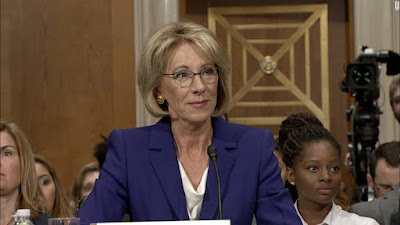
Teachers Call Trumps Billionaire Education Secretary Nominee Public Education Enemy #1


Trump nominee for Education Secretary faces fierce criticism from teachers unions that she is working against public education. 

This belief was reinforced when billionaire Betsy DeVos - dubbed public school enemy # 1 -  refused to answer important direct questions critical to people with limited financial resources and those with disabilities. And perhaps most surprising response came when questioned by Senator Chris Murphy of Connecticut the safety of our children in school. Her response on having guns in schools; guns in schools could 'protect from potential grizzlies' 

When asked does she agree that schools who receive federal funding be held to the federal law? Specifically of IDEA (Individuals with disabilities act), bullying and violence? She was nonresponsive and when pushed,  finally said she would leave bullying to the states and she never responded to the question on IDEA.  When asked if vouchers - a program she has championed - would be made available to children enrolled in both special education and general education, she did not respond, rather she skirted the question and referred to a scholarship program in Florida. 

My question now is, how does someone seeking the highest education post in the United States, and a critical post for the future of this country not have a response to these legal, ethical and moral questions?

Asked outright by Sen. Bernie Sanders of Vermont whether she got the job because of her family's political contributions, DeVos said: "As a matter of fact I do think that there would be that possibility. I have worked very hard on behalf of parents and children for the last almost 30 years."
On tuition-free public colleges and universities, DeVos said: "I think we also have to consider the fact that there is nothing in life that is truly free. Somebody is going to pay for it."
She skirted Sanders' question on whether she would support making childcare free or much more affordable for low-income families as is the case in many countries, saying only that she felt strongly about "parents having opportunities for childcare for their children."  
"But it's not a question of opportunity," Sanders fired back, raising his voice. "It's a question of being able to afford it!"
Responding to fierce criticism from teachers unions that she is working against public education, DeVos told the committee that she would be "a strong advocate for great public schools."
"But," she added, "if a school is troubled, or unsafe, or not a good fit for a child — perhaps they have a special need that is going unmet — we should support a parent's right to enroll their child in a high-quality alternative."
Ethics and morality play a role in education, and it seems to me Ms. DeVos is unclear on her position when it comes to those less fortunate then herself.