Showing posts with label employment. Show all posts

Wednesday, November 13, 2024

Amazon's War on Workers: New Disability Policy and Union-Busting Tactics Spark Outrage

Amazon is making it harder for disabled employees to get permission to work from home. 

The company recently told employees with disabilities that it was implementing a more rigorous vetting process. Affected workers must submit to a “multilevel leader review” and could be required to return to the office for monthlong trials to determine if accommodations meet their needs. The revised disability policy—which hasn’t previously been reported—is roiling a workforce already alienated by a five-day return-to-office mandate. Meanwhile, the National Labor Relations Board ruled (in a case involving Amazon) that mandatory “captive audience” meetings are illegal. These are the gatherings where companies tell employees the alleged evils of unionization, and are one of their most potent weapons against labor organizing. 

Please if you feel like I feel voice your concern, and depending on your level of outrage any of the following will do!

1. Contact Amazon Directly:

Customer Service: While this might not be the most direct route, you can reach out to Amazon's customer service by phone at 1-888-280-4331 and share your concerns.

  • Social Media: Use platforms like Twitter or Facebook to directly message Amazon or tag them in posts using relevant hashtags.

2. Reach Out to Regulatory Agencies:

  • Equal Employment Opportunity Commission (EEOC): The EEOC enforces laws prohibiting job discrimination. You can file a complaint with them if you believe Amazon's policy violates these laws.
  • National Labor Relations Board (NLRB): While this might not be directly related to the disability policy, the NLRB oversees labor relations and can investigate potential unfair labor practices.

3. Contact Advocacy Organizations:

  • Disability Rights Organizations: These organizations often advocate for the rights of people with disabilities. Contact them to learn about potential legal actions or public campaigns you can support.

4. Public Pressure:

  • Sign Petitions: Look for online petitions against Amazon's policy and sign them to show your support.
  • Write Letters to the Editor: Share your concerns with local newspapers and online publications.
  • Boycott Amazon: Consider reducing your purchases from Amazon as a form of protest.

Remember, your voice matters. By taking action, you can help ensure that disabled workers are treated fairly and have the opportunity to work remotely if needed.


Friday, January 22, 2016

Teens With Autism Exit High School As Social/Functional Illiterates

Nick Working in HS Cafeteria

"The first battle was getting the school to buy into the reality that no matter how much time Nick spent in a Special Day Class, no matter well he was doing and no matter what he learned, if he could not translate that knowledge directly into a vocation or show how it improved his independence, it was USELESS"   


I don't know about any of you, but Nick was on track to age out of school no closer to being able to live independently than he was when he began!  I'm not saying he didn't learn anything, Nick is a smart kid; he can read, he can write, he can speak better, he can add and these are all essential tools and yes, much he learned in school.  At the same time, he can't access his community to use these skills, when he can't walk across the street on his own, work with money, use public transportation and he doesn't know what a stranger is, has no sense of danger, and can't monitor time for himself for any other purpose than to keep track of what he is going to get and when.  So, in reality as far as being independent Nick is my version  of a social/functional illiterate. It's sad but true, because for all the great things he has learned if he isn't able to or taught to apply them to a job, or success in the community, what has he really accomplished?.  This isn't just Nick I'm hearing this from parents everyday, so it's not just a Nick issue.   Despite my tremendous disappointment the truth is the system is what it is, IMPERFECT and overwhelmed, and unprepared to individually educate our children.  So we are in a place where we get out of it what we put into it.  When Nick was first diagnosed people told me Autism was a survival of the fittest disease, and that is still true today, so I blame no one.  I take that back, if blame were to be passed out, I would pass it me, Nick's mom because I know better.  


When I started this journey I thought the challenge was early intervention, because no one knew about autism.  I was wrong, now everyone has heard about it and it's still every man for themselves, one kid, one program, one outcome at a time all measured by how much we each can put into the process.  Sad but true, the buck always come back to parents and caregivers. 

Here's what we are doing to improve Nick's outcome after HS. 
I'm sure many of you can give me more input on how you're making progress.

We have been working on vocational skills in various forms for Nick since he was 10, in hopes of improving his level of independence.  Like I said, I thought the system would move with us and support Nick, especially once he entered high school and I was wrong.  Sadly, when our kids get to high school we are tired, and most of us get little exposure to the classroom, we get daily reports that all is well, and relieved to get a break from fighting,  we embrace good news and trust that the system is giving our young adults what they need.  I've learned that is not the case for us.  So many years into this journey I've learned Nick memorized more than he actually learned in class, then over time he would forget what he memorized because the information did not have any real meaning for him.  Nick did not retain a great deal of the useful information exposed to in the classroom because he did not have the opportunity to  "generalize" the information or skills in the real world, so it's more "Drill and Kill" than real learning for Nick.  This wasn't a big worry when he was in elementary school, but it's critical now and there are few options for him to generalize what he has learned in work place settings, given he's not 18 yet.  And when he turns 18 the pickings are still slim in our area.  In LAUSD the ASD classes do not even offer - what is available to other developmentally disabled special education classrooms - Community Based Programs (CBI)!  Sounds crazy, but true.  That said,  there was no way I wanted to see my son age out of school, having sat in a classroom for years, filled with information yet exiting no closer to being able to live independently than when he began!  I promise this would have been the case if I left him in the hands of the well intended, who measured his success based upon his ability to perform the work in the classroom.  
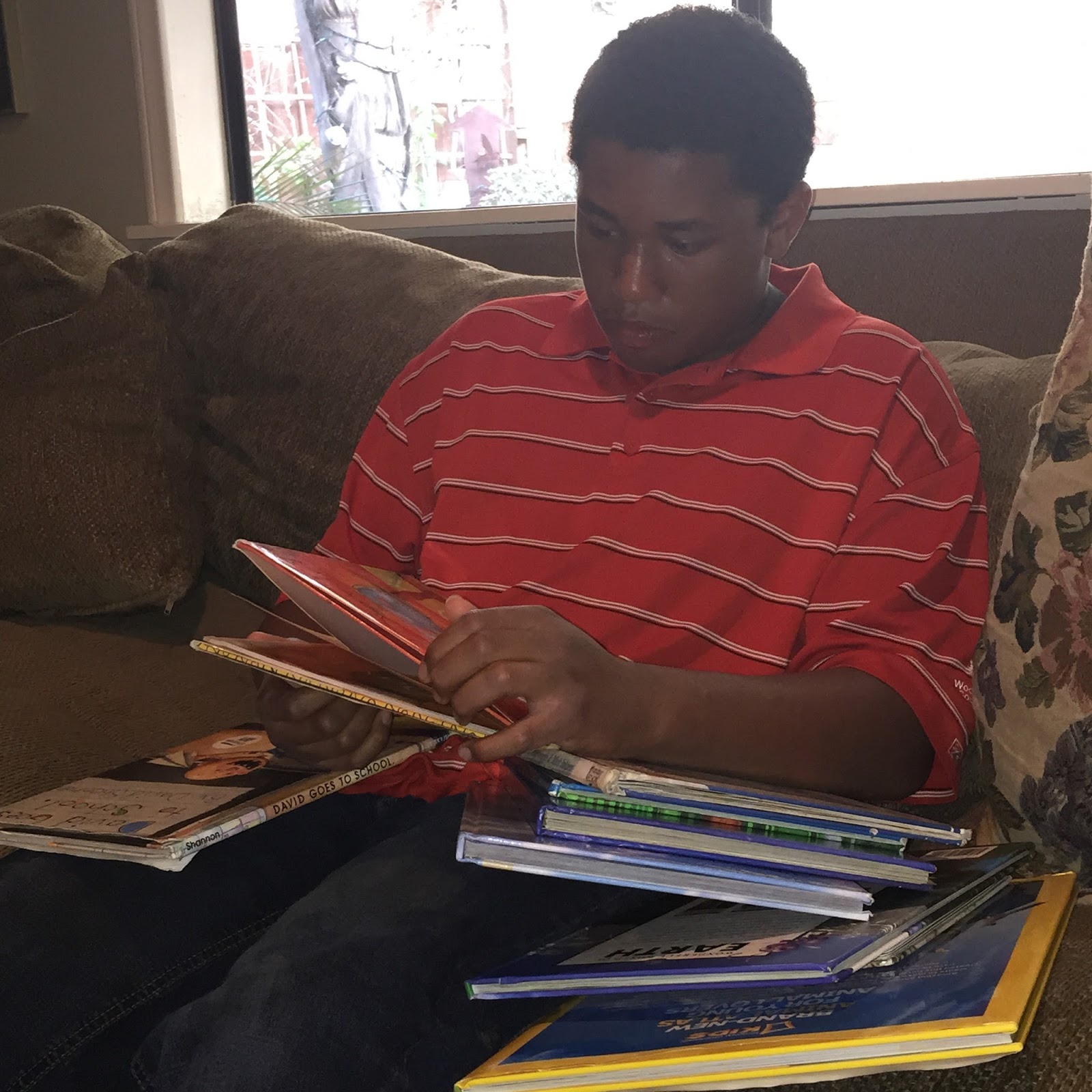
Nick loves Books....him just hanging our reading.

I'm happy to report that we've made progress and I wanted to share the process.   The first battle was getting the school to buy into the reality that no matter how long Nick spent in the SDC, no matter what he learned in the classroom setting, if he could not translate it directly into a vocation or show how it improved his independence, it was USELESS. A big ouch for educators who are well intended.  For example,  if Nick can do math in the workbooks in class, but he can't translate basic addition and subtraction to money, he can't independently  buy things from a bus pass, to groceries or clothing and he can't order and pay in a restaurant, so have to cross out one of the most basic skills required for independence.  
The second battle, was mediation because even once the school bought into the idea, they had no programs and the district rules said they could not create one. Nick was required under the rules of "Common Core" to remain in the classroom, take all the coursework so he could test and pass the standards.  What's funny about this in Nick's case is HE IS NOT ON THE DIPLOMA TRACK AND WON'T BE GETTING A DIPLOMA - BUT THEY STILL SAID HE HAD TO CONTINUE WITH THE COURSEWORK!!!  Fortunately  Federal law provided support, because the point of an IEP is to create the best educational program for each child. That said, the district finally agreed, and the school was given permission to create a real Individualized Education Program for Nick!   

Third, now that he could come out of the classroom, where to put him?  I had been building a relationship with school leadership for years, and had a team open to do the work needed to build a unique program inclusive of gen ed teachers willing to accept and support  Nick.  I know you're all really surprised to learn that all general education teachers are not open to having our kids in their classroom! LOL.   Then we had to build a program where he could spend  his day learning to use  what he's learned in class for the past 14 years in various settings, with a focus on vocational skills.  Here's his schedule now:
Nick Dressed Up To Sing in School
Choir Holiday Program! 
  • Homeroom (SDC)
  • PE (APE)
  • Language Arts (SDC)
  • General Ed Ceramics (where he does ceramics which he loves and helps the teacher with jobs)
  • Teachers Aid (TA) - For PE Coach 
  • General Ed Choir - Where he sings which is building new brain connections and he works on his social skills and functioning in a group.
  • Cafeteria Worker - Does various jobs as asked by supervisor 
  • Afterschool -  Farm Program 
The Forth Challenge is keeping it going and pushing vocation and independence at home. Our program started with one thing at a time and now when he comes home where he has chores, broken down into Daily (AM, Afterschool, Night time), Weekly and sometimes. 


  • Feed the dogs
  • Give the dogs water
  • Clean up after the dogs in the yard
  • Put clean silverware away
  • Take the trashcans out on trash pick up day
  • Organize cloths for the week
  • Empty Dishwasher
  • Gather his dirty laundry
  • Sort mom's filing alphabetically (new I'm tapping into this love for letters)
  • Shed papers 
  • Take out trash and recycle


He is learning how to follow instructions to cook. We use mix's so he can read the box (i.e. cookies, mac and cheese). We are starting with his favorites! Even a simple direction followed precisely with measuring is a big deal for us!  This is a place where he gets immediate reinforcement for using math! 


So that's what I have share your ideas.
.

Thursday, January 21, 2016

4 Major Companies Are Tackling The Autism Unemployment Epidemic

Learning 4 Major Companies Are Tackling The Autism Unemployment Rate Gave Me a Bit of Hope for Nick's future. 

Thank God we live in a country where private industry can focus on social good, and make an impact in our communities. Thank you Microsoft, Walgreens, Freddie Mac and SAP! 

We have a Walgreens down the street where Nick get's his prescriptions. They are like an extension of our family, always asking how he is doing, giving him compliments. This makes me wonder, maybe Nick can work there one day! 


For adults with Autism Spectrum Disorder, employment prospects are often disappointingly few and far between.According to a 2013 report published in the Journal of the American Academy of Child & Adolescent Psychiatry, the underemployment starts early. Just over 50 percent of young adults with ASD worked for pay outside the home within eight years after they finished high school. And when they did, the work was part-time and low-paying more often than not. Only about 20 percent of young adults with ASD worked full-time at either a current or a most-recent job, and their average pay was just $8.10 an hour.


Tuesday, October 13, 2015

Wednesday, January 21, 2015

2.5 Million Readers Pick Top Posts for 2014

Autism Day By Day - 2.5 Million Readers Pick Top Posts for 2014
What a year! Autism Day by Day became an official National Institute of health resource and more than 2.5 million of you logged onto Autism Day by Day. When the year was over you had unanimously picked the following posts to make up the top 20 reads! Your favorites covered every topic from Bullies to Puberty, Police to Cover Up's at the CDC, Joy of Surfing to Statistics, Employment and what makes us really mad, these are the posts that got your attention.  

MIT Reports 1/2 of all US Children will have autism by ..

A Candid Conversation with A Cop - Be afraid!

​​National PSA address's Autism Related Wandering; Spread the Word!

Bullies without Boundaries!
 
Puberty, Part II Managing Masturbation! A must read for Moms

11 Ted Talks to a Happier Life! 
  
CDC Vaccine Cover Up Reported

Disney Faces More Heat in Autism Lawsuits

A Must See Video!  Autism + Surfing = Pure Joy!

Police and Autism a Dangerous Mix

​​​Autism Online Job Board

Disney Law Suit

There may soon be a way to genetically test children for ASD


Why "Retarded Needs to Be Retired"

Employment Improves Autism Symptoms

Autism and Meditation - A good mix!


Monday, March 24, 2014

Toil, abuse and endurance in the heartland. How is this NOT my son's future?

The 'Boys' in the Bunkhouse

Toil, abuse and endurance in the heartland, sad doesn't quite describe it. However, there seems to be a silver lining thanks to those who care. It's a critical reminder of what can happen to our children when nobody is watching.

This front page article by Dan Barry is the story of dozens of men with intellectual disabilities who were held as virtual slaves in squalid conditions in a small town in Iowa and forced to work at a chicken processing plant for over 30 years.  They were paid a subminimum wage and this case is thought to have influenced President Obama in his recent decision to include people with disabilities in his executive order to raise the minimum wage of employees under federal contracts.  The link includes a 35-minute documentary about the men.  I've taken out the pictures, but they really are important to the story. Worth the read and view... 

THIS LAND By DAN BARRY MARCH 9, 2014
WATERLOO, IOWA — A man stands at a bus stop. He wears bluejeans, cowboy boots, and a name tag pinned like a badge to his red shirt. It says: Clayton Berg, dishwasher, county sheriff’s office.
He is 58, with a laborer’s solid build, a preference to be called Gene and a whisper-white scar on his right wrist. His backpack contains a jelly sandwich, a Cherry Coke and a comforting pastry treat called a Duchess Honey Bun.
The Route 1 bus receives him, then resumes its herky-jerky journey through the northeastern Iowa city of Waterloo, population 68,000. He stares into the panoramic blur of ordinary life that was once so foreign to him.
Mr. Berg comes from a different place.
For more than 30 years, he and a few dozen other men with intellectual disabilities — affecting their reasoning and learning — lived in a dot of a place called Atalissa, about 100 miles south of here. Every morning before dawn, they were sent to eviscerate turkeys at a processing plant, in return for food, lodging, the occasional diversion and $65 a month. For more than 30 years.
Their supervisors never received specialized training; never tapped into Iowa’s social service system; never gave the men the choices in life granted by decades of advancement in disability civil rights. Increasingly neglected and abused, the men remained in heartland servitude for most of their adult lives.
This Dickensian story — told here through court records, internal documents and extensive first-time interviews with several of the men — is little known beyond Iowa. But five years after their rescue, it continues to resound in halls of power. Last year the case led to the largest jury verdict in the history of theEqual Employment Opportunity Commission: $240 million in damages — an award later drastically reduced, yet still regarded as a watershed moment for disability rights in the workplace. In both direct and subtle ways, it has also influenced government initiatives, advocates say, including President Obama’s recent executive order to increase the minimum wage for certain workers.
Overall, the Atalissa case has been a catalyst for change, according to SenatorTom Harkin, Democrat of Iowa, a longtime champion of people with disabilities, who still struggles with what these vulnerable men endured in his home state.
“I hate to see what happened to them,” the senator says. “But, by gosh, something might happen from them.”
The dark tale of Mr. Berg and his work mates has spurred introspection in Atalissa and beyond about society’s perception of those with disability. About what is noticed, what is not and what remains in need of constant vigilance.
“The turkey plant case has really haunted all of us,” says Curt Decker, the executive director of the National Disability Rights Network. “This is what happens when we don’t pay attention.”
This Waterloo bus does not go to Atalissa. But the man in cowboy boots, rocking to its gentle sway, needs only to notice that telltale scar on his wrist, and he is instantly returned.Gene Berg waiting for the Route 1 bus in Waterloo, Iowa, and on his way to his job as a dishwasher at the Black Hawk Sheriff's Office. Nicole Bengiveno/The New York Times
The Scene
A veteran social worker named Denise Gonzales drove past the winter-quiescent fields of 2009 to some town called Atalissa. She had to see for herself what subordinates were telling her.
She pulled uphill to an old schoolhouse, its turquoise exterior garish amid the sleeping acres of snow-dusted brown. She found an open door and stepped into a wonderland nightmare, with walls painted playhouse colors, floors speckled with roaches and the air rank with neglect.
From the squalid building’s shadows emerged its residents, all men, extending hands in welcome, their long fingernails caked with dried blood. A few hands looked almost forked. “From pulling crop,” they explained, a term that she soon learned referred to the yanking of craws from freshly killed turkeys.  

more at http://www.nytimes.com/interactive/2014/03/09/us/the-boys-in-the-bunkhouse.html?_r=0

Wednesday, March 12, 2014

Employment May Lead To Improvement In Autism Symptoms

Love this! One more reason why we need quality vocational programs NOW!!! The question is, how are we going to make sure our kids are employable? What support(s) will be made available to insure employment is an option for all of our kids?  
Donna

Employment May Lead To Improvement In Autism Symptoms

January 14, 2014
Vocational Skills begin at home! 
Vanderbilt University
More independent work environments may lead to reductions in autism symptoms and improve daily living in adults with the disorder, according to a new study released in the Journal of Autism and Developmental Disorders.

Researchers at Vanderbilt University and the University of Wisconsin-Madison examined 153 adults with autism and found that greater vocational independence and engagement led to improvements in core features of autism, other problem behaviors and ability to take care of oneself. "We found that if you put the person with autism in a more independent vocational placement, this led to measurable improvements in their behaviors and daily living skills overall," said lead author Julie Lounds Taylor, Ph.D., assistant professor of Pediatrics and Special Education and Vanderbilt Kennedy Center investigator. "One core value in the disability community and at the Vanderbilt Kennedy Center is placing people with disabilities in the most inclusive environments possible. In addition, this study gives us evidence that increasing the level of independence in an employment or vocational setting can lead to improvements in autism symptoms and other associated behaviors."

Participants averaged 30 years of age and were part of a larger longitudinal study on adolescents and adults with autism. Data were collected at two time points separated by 5.5 years.
Taylor, in collaboration with colleagues at the University of Wisconsin-Madison, looked at such autism symptoms as restricted interests, repetitive behaviors, communication impairments and difficulties with social interactions and found the degree of independence in vocational activities was uniquely related to subsequent changes in autism symptoms, other problem behaviors and activities of daily living.
The results provide preliminary evidence that employment may be therapeutic in the development of adults with autism. Similar to typically developing adults, vocational activities may serve as a mechanism for providing cognitive and social stimulations and enhance well-being and quality of life.

"The majority of research on autism has focused on early childhood, but autism is a lifelong disorder with impairments that limit quality of life throughout adulthood," Taylor said. "Given the prevalence of autism, now one in 88 children, we must continue to examine the factors that promote well-being and quality of life for adults with autism and other disabilities as a whole."

Underemployment is a common phenomenon among adults with autism, the authors noted, with around 50 percent of adults with autism primarily spending their days with little community contact and in segregated work or activity settings.

Taylor says this research highlights the importance of employment programs for adults with autism and stresses the need for more intervention programming for this population.

Story Source:
The above story is based on materials provided by Vanderbilt University. The original article was written by Jennifer Wetzel. Note: Materials may be edited for content and length.
Journal Reference:
1.     Julie Lounds Taylor, Leann E. Smith, Marsha R. Mailick. Engagement in Vocational Activities Promotes Behavioral Development for Adults with Autism Spectrum DisordersJournal of Autism and Developmental Disorders, 2013; DOI:10.1007/s10803-013-2010-9