Showing posts with label Aging Out. Show all posts

Thursday, September 17, 2020

Autism; Aging Out in a Covid Pandemic – Part I


"Aging Out" - A Mom Releases Fear Built Over a Lifetime. 

For years I have lived with fear. Fear that feels like a quiet hum; always buzzing on the fringe of my consciousness. Fear, I think every parent who has relied on educational and therapeutic support for their child's care can relate to. 

It is fear of what those of us in the developmental disabilities community calls “Aging Out”, and it’s our collective Boogie Man!

For most of our children there will be no ongoing education, no higher-level learning, no exciting jobs, careers, dating, independent travels, marriage or children. Like other kids they graduate from high-school with lots of congratulations and accolades for a job well done, but the words fall flat when they are sent home to nothing or lack luster day programs. 

Since his diagnosis, I imagined by the time he graduated from high school there would be a variety of viable educational, work and life programs for this growing population. That has not been the case. The pickings are slim and although many programs sound good and the brochures look great, underneath, today's programs are not much different than the day programs of the past.  That is why I see images of my son – who deserves to continue to grow and learn like everyone else – overweight, being driven around town in a white van, eating donuts and junk food walking with a colorful rope tied around his waist. The rope connects him to another person with developmental disabilities, who connects to another and this continues until the group forms a long line connecting them as they all walk shopping malls and assorted destinations with no real purpose. The thought of that being his life once he “aged out” is what I have been afraid of since he was diagnosed with autism 20 years ago.


But few things happen exactly as we imagine, including “Aging Out”. Thanks to Covid 19 Nick effectively aged out sooner than planned.  But it wasn’t just our household facing this drastic shift, the entire world was sent home, not just Nick.   And instead of going from graduation to no supports, last March we were thrown into a different kind of chaos eliminating school, friends and supports over a 5-month period instead of overnight.  

Instead of his school experience and supports ending the summer school concluded, Nick went from school to home, to online school (not useful for Nick) to online graduation, to online summer school, to nothing. Amidst the chaos of Covid all families were stressed with change, everyone was home, and there was nowhere for him to go because everything was closed. So instead of “Aging Out” being the biggest concern in my world, it was just one of them.


 I was not alone is sudden change, which in a weird way seemed to soften the impact of the moment and what was to come. I was just like every parent in the country struggling to figure out what to do with children who were suddenly home all day!   I was like all the other parents struggling to be their kid’s teacher, coach and playmate while trying to work myself in a Covid-19 world.  I don’t mean to be a jerk, but there was something oddly comforting about knowing I was not alone, because in a way all of our kids had just “Aged Out”, even if only temporarily. Ironic that families around the world were experiencing the pain and panic I knew was coming, but they never expected.


I however, did have an advantage over most parents because this is not my first fear rodeo! This phase mirror’s the early stages when Nick was diagnosed with Autism. While other 2- and 3-year old’s were going to preschool, I was sent home, with my nonverbal 2-year-old kiddo in tow, to figure out our life on our own. Armed only with the knowledge that autism was a lifelong developmental disability with no known cause or cure that would require lifelong care. I remember feeling like I was staring into the abyss with no idea what to do, where to go, what would come next or how we would handle it.  It’s been a long journey from diagnosis to aging out. Yes, I am fatigued, but I am so grateful to have made it here. As I stare down the tunnel of what’s next, I am hoping the bright light, is a flashlight to guide me and it is not a train.

Parents of most neurotypical children anticipate a life after high school graduation for their children as a stepping stone into the future. A future, commencement speeches describe as filled with purpose, hope and optimism. That is not the reality of most families raising children with autism and other developmental disabilities. We don’t experience graduation as the start of a new chapter filled with exciting possibilities, purpose, college or work, dating, marriage and children. Instead the landscape for life after high school for our children looks like the end of their best times, a downhill slope offering little or no hope for the future.


Why? Because the world does not value investing in their ongoing education or building a future for our children.  I took Nick off the diploma track to delay this moment as long as I could. Leaving the diploma track meant he could stay in school until he turned 22. Staying in school provided an opportunity for him to continue to learn, while staying engaged in a safe regular routine with his friends for as long as possible. I took him off the diploma track while he was in middle school specifically to postpone the inevitable; the day school would end and with it  options for an engaging fulfilling life. 

Since his diagnosis, I imagined by the time he graduated from high school there would be a variety of viable educational, work and life programs for this growing population. That has not been the case. The pickings are slim and although many programs sound good and the brochures look great, underneath today's programs are not much different than the day programs of the past.  That is why I see images of my son – who deserves to continue to grow and learn like everyone else – overweight, being driven around town in a white van, eating donuts and junk food walking with a colorful rope tied around his waist. The rope connects him to another person with developmental disabilities, who connects to another and this continues until the group forms a long line connecting them as they all walk shopping malls and assorted destinations with no real purpose. The thought of that being his life once he “aged out” is what I have been afraid of since he was diagnosed with autism 20 years ago.

But few things happen exactly as we imagine, including “Aging Out”. Thanks to Covid 19 Nick effectively aged out sooner than planned.  But it wasn’t just our household facing this drastic shift, the entire world was sent home, not just Nick.   And instead of going from graduation to no supports, last March we were thrown into a different kind of chaos eliminating school, friends and supports over a 5-month period instead of overnight.  Instead of his school experience and supports ending the summer school concluded, Nick went from school to home, to online school (not useful for Nick) to online graduation, to online summer school, to nothing. Amidst the chaos of Covid all families were stressed with change, everyone was home, and there was nowhere for him to go because everything was closed. So instead of “Aging Out” being the biggest concern in my world, it was just one of them.

 I was not alone is sudden change, which in a weird way seemed to soften the impact of the moment and what was to come. I was just like every parent in the country struggling to figure out what to do with children who were suddenly home all day!   I was like all the other parents struggling to be their kid’s teacher, coach and playmate while trying to work myself in a Covid-19 world.  I don’t mean to be a jerk, but there was something oddly comforting about knowing I was not alone, because in a way all of our kids had just “Aged Out”, even if only temporarily. Ironic that families around the world were experiencing the pain and panic I knew was coming, but they never expected. 

I however, did have an advantage over those parents who had not been caring for their children 24/7, because this was not my first fear rodeo! I had experience providing all of his education at home, and I since my son didn't have friends, or playdates I was used to providing his social life. Who, know that would be an upside! But it was because this phase of our journey mirror’s the early stages when Nick was diagnosed with Autism. When I was sent home armed only with the knowledge that autism was a lifelong developmental disability with no known cause or cure, that would require lifelong careWhile other 2- and 3-year old’s were going to preschool, I was home with my nonverbal 2-year-old kiddo trying to figure out life on our own and learning how to be everything to my child. 

I remember feeling like I was staring into the abyss with no idea what to do, where to go, what would come next or how we would handle it.  
It’s been a long journey from diagnosis to aging out. Sometimes moving unbelievably fast, and other times painfully slow.  But we made it. We are staring down the tunnel of what’s next. Praying and hoping the bright light at the end, is a flashlight to guide us and it is not a train.


Monday, May 4, 2020

Covid 19 Impact on Public Education: De Vos takes high road leaving (IDEA and the Rehabilitation Act) untouched

President Trump talks with Education Secretary Betsy DeVos during a meeting with parents and teachers in the Roosevelt Room of the White House in Washington on Feb. 14. (Jabin Botsford/The Washington Post)Covid 19 Impact on Public Education: De Vos takes high road leaving (IDEA and the Rehabilitation Act) untouched. As a result we must still wait to see what States and School Districts agree to provide compensatory education services to those enrolled in special education programs. 


U.S. Secretary of Education Betsy DeVos will not seek changes to the central tenets of the Individuals with Disabilities Education Act in response to the coronavirus pandemic.
In a report to Congress released late Monday, DeVos recommended that lawmakers consider what the Department of Education called “additional flexibilities on administrative requirements.”
But, DeVos said in the 18-page document that her agency “is not requesting waiver authority for any of the core tenets of the IDEA or Section 504 of the Rehabilitation Act of 1973, most notably a free appropriate public education (FAPE) in the least restrictive environment (LRE).”
The report came at the request of Congress, which as part of a federal stimulus law approved in late March, gave DeVos 30 days to provide recommendations for any waivers she thought necessary under IDEA to “provide limited flexibility” to states and school districts during the emergency.
Disability advocates were unequivocal that they thought no waivers were needed even as most of the nation’s schools remained shuttered. But, groups representing school administrators had reasoned that given the extraordinary circumstances, temporary modifications were justified.
“We undertook this task acknowledging the reality that most students and teachers are at home today; yet, America’s teachers want to keep teaching and students need to keep learning,” DeVos said in a statement. “While the department has provided extensive flexibility to help schools transition, there is no reason for Congress to waive any provision designed to keep students learning. With ingenuity, innovation and grit, I know this nation’s educators and schools can continue to faithfully educate every one of its students.”
The Education Department said that the recommendations were rooted in several key principles including that learning must continue for all students, decision-making should be based on what’s best for students, parents must be informed of how waivers would impact their kids and services that have traditionally been provided in-person will have to be done differently.
“The secretary determined there is no reason that a student’s access to FAPE cannot continue online, through distance education or other alternative strategies,” the agency said in an announcement about the report.
DeVos is recommending that Congress allow her agency waiver authority to ensure that children with disabilities can continue receiving services after they turn 3 if the pandemic delays an evaluation that’s supposed to happen at that juncture. The secretary is also seeking changes to requirements of IDEA personnel development scholarships and more flexibility in funding for vocational rehabilitation.
“I am pleasantly surprised that it appears that the secretary did not succumb to pressure and chose the high road to leave the important provisions of both (IDEA and the Rehabilitation Act) untouched,” said Denise Stile Marshall, CEO of the Council of Parent Attorneys and Advocates, or COPAA, a nonprofit that represents special education attorneys.
Officials with AASA, The School Superintendents Association, as well as the National Association of State Directors of Special Education and the Council of Administrators of Special Education — which had all pushed for temporary IDEA flexibilities — did not immediately offer comment on the report.

Wednesday, September 6, 2017

What Wikipedia Can't Tell You about Autism and Graduation Ceremonies

I know I'm late to the graduation party, but I didn't want to miss sharing this. 

On graduation day I invited friends and family and therapists to come so we could all cheer and celebrate this momentous day we all worked so hard for.  Huddled together on the bleachers we were all excited screaming "Go Nick", clapping and cheering as he walked out to take his seat. We were just like all the other families celebrating each graduates success and the joy of knowing this was the beginning of what we all hoped would be an exciting chapter for our children, the dawn of a new day.

As the valedictorian talked about their future, what each student will do next, the contributions they will make to the world, and the thrill of the academic, personal and professional journey ahead, something snapped in me, and my excitement was gone. My stomach tightened as a wave of profound sadness, borderline nausea passed through me and I went from feeling like all the other parents to an actor in a play, a fraud an imposter pretending to be like the other parents, pretending to fit in because this sounded nothing like Nick’s future, nothing like our life.  I put my head down to cover my face and hide the tears flowing from my eyes. 

I stopped hearing or seeing the ceremony as my mind began racing with thoughts “What the hell! Am I crazy? What am I celebrating? Nick is walking but he’s not getting a diploma. He’s not like these other kids. What future, mall walker!!!? This is not the start of an exciting future for Nick we’re just getting closer and closer to the world where there is no place for him, a world where one day I won't be here to protect him!”  And all of the joy of the moment evaporates. I tell myself to snap out of it and I pick up my head and go back to watching the ceremony. I do the right thing, and I yelled in support as he walked across the stage.

Finally, the ceremony ends and we all rush down to the field.  I’ve put on my happy face, still unable to silence the thoughts in my head and the grief I'm feeling.   

Then, I see Nick who is exploding with joy and what looks like pride as he jumps and smiles and laughs clutching his certificate.  His joy is so big, so infectious my grief vanishes and I realize this is the point, this moment, these feelings right now and not what is next. It doesn’t matter if he isn’t like the other students, it doesn’t matter if his future won’t be like theirs, it would not be like theirs even if he was typical. It doesn't matter if he isn't holding a diploma or know what all of this means.  The truth is each student faces the unknown, just as much as Nick does, some will have a better future, so will not. But I do know what every parent wants most is for our child to be happy, and mine was probably the happiest one there!  

I watch everyone congratulate Nick, I see my beautiful happy boy and I am so relieved I didn’t let all the thoughts in my head, and my concerns for his future, rob me of the joy of the moment.  Note to self, the past is gone, the future is unknown, so remember mama to stay in the now, or risk missing something pretty damn amazing!


Wednesday, July 20, 2016

The Future of Autism


Does anyone else wonder why it is that High School Graduation marks the beginning of an exciting journey for typical teens, and in contrast it's the end of the road for individuals with Autism?  

A conversation with a typical teens. 
Congratulations, you graduated and we're so proud of you. Now go to college, or travel, or get a job. Have fun, learn, make mistakes, try on what fits to see what you want to do with your life.


A conversation with a teen with autism: 
Congratulations, your parents took you off the diploma track so you can stay in HS for 3 more years! You will have a place to come everyday until you turn 22!  After that, well you go home and your folks help you figure out how to fill your day.

Opps, your family didn't know what had to be done to continue your education a few more years :(, and you're not college material?  Congratulations you graduated!!! That's it, go home and be proud. Take a break until your family finds programs to help fill your day.


Monday, June 20, 2016

Rejection is Unbearable! Where Do Teens With Autism Go? The Reality for mid functioning teens with ASD.

Today I feel so sad and discouraged. Lately every door I fight to open for Nick gets closed. Seems the answer is the same wherever I go. Church camp Summer Retreat, "NO", 

 Vocational School, "NO", Summer Camp...just kicked out. He's just not, well "enough".  Not independent enough, not behaved enough, not spiritual enough.


Nick is not high functioning when it comes to socialization, and he's not low functioning. When frustrated he might go along, or he might tantrum. He might go months without a single community outburst, but if he has one, it's back to the drawing board. It's like all progress has been erased in the eyes of the world. It's just not enough.

He's an in-between, and there is not place for "in-betweens". No where is there a bridge that takes him from here to there. But I am not willing to settle.  

Monday, February 8, 2016

Teen with ASD Would Rather Be Cool than "Different" The Pain of Knowing.


This from a mom about her son with autism.

Mattey doesn't like to think of himself as having Autism. I get it. It makes him seem sound different. He doesn't want to be different. He wants to be him. He wants to be "cool", and have a good reputation (even if his version isn't what I have in mind as "good"). He wants to have a girlfriend, and even wants to downplay his intelligence, by doing bad in school.. or at least not perform to the level he's capable of.

Since he isn't okay with having Autism, he isn't okay with all of the things that go with it- counseling, for one. Yesterday I had to explain to him that Autism is much like his asthma, or my Lyme, or any other number of issues. They have to be treated. The treatments are boring, or may even seem pointless. But they need to be done. Only once we reach a certain point in our treatment may the doctor tell us that we don't need as much medicine (or therapy, or whatever), and may not need to see them as often. Acting out merely proves that he's not ready to have these things phased out.

More importantly, he's not going through this alone. For as much as he wants to deny this part of him (which again, I liken to asthma- it's part of his make up, and nothing "bad", or "wrong"), he's not the only one going through it. Every day, our entire family- everyone he knows and interacts with on a daily basis- is going through it with him, even if to a lesser degree. It may take him years to understand or even remotely appreciate that. We're not him, so there's no way to understand his struggle. But we're having to share this experience with him, whether or not he wants to accept the word "Autism". We're still here to help him, for all of his rejection and denial.
So, yes. It is hard. (For everyone).

Friday, January 22, 2016

Teens With Autism Exit High School As Social/Functional Illiterates

Nick Working in HS Cafeteria

"The first battle was getting the school to buy into the reality that no matter how much time Nick spent in a Special Day Class, no matter well he was doing and no matter what he learned, if he could not translate that knowledge directly into a vocation or show how it improved his independence, it was USELESS"   


I don't know about any of you, but Nick was on track to age out of school no closer to being able to live independently than he was when he began!  I'm not saying he didn't learn anything, Nick is a smart kid; he can read, he can write, he can speak better, he can add and these are all essential tools and yes, much he learned in school.  At the same time, he can't access his community to use these skills, when he can't walk across the street on his own, work with money, use public transportation and he doesn't know what a stranger is, has no sense of danger, and can't monitor time for himself for any other purpose than to keep track of what he is going to get and when.  So, in reality as far as being independent Nick is my version  of a social/functional illiterate. It's sad but true, because for all the great things he has learned if he isn't able to or taught to apply them to a job, or success in the community, what has he really accomplished?.  This isn't just Nick I'm hearing this from parents everyday, so it's not just a Nick issue.   Despite my tremendous disappointment the truth is the system is what it is, IMPERFECT and overwhelmed, and unprepared to individually educate our children.  So we are in a place where we get out of it what we put into it.  When Nick was first diagnosed people told me Autism was a survival of the fittest disease, and that is still true today, so I blame no one.  I take that back, if blame were to be passed out, I would pass it me, Nick's mom because I know better.  


When I started this journey I thought the challenge was early intervention, because no one knew about autism.  I was wrong, now everyone has heard about it and it's still every man for themselves, one kid, one program, one outcome at a time all measured by how much we each can put into the process.  Sad but true, the buck always come back to parents and caregivers. 

Here's what we are doing to improve Nick's outcome after HS. 
I'm sure many of you can give me more input on how you're making progress.

We have been working on vocational skills in various forms for Nick since he was 10, in hopes of improving his level of independence.  Like I said, I thought the system would move with us and support Nick, especially once he entered high school and I was wrong.  Sadly, when our kids get to high school we are tired, and most of us get little exposure to the classroom, we get daily reports that all is well, and relieved to get a break from fighting,  we embrace good news and trust that the system is giving our young adults what they need.  I've learned that is not the case for us.  So many years into this journey I've learned Nick memorized more than he actually learned in class, then over time he would forget what he memorized because the information did not have any real meaning for him.  Nick did not retain a great deal of the useful information exposed to in the classroom because he did not have the opportunity to  "generalize" the information or skills in the real world, so it's more "Drill and Kill" than real learning for Nick.  This wasn't a big worry when he was in elementary school, but it's critical now and there are few options for him to generalize what he has learned in work place settings, given he's not 18 yet.  And when he turns 18 the pickings are still slim in our area.  In LAUSD the ASD classes do not even offer - what is available to other developmentally disabled special education classrooms - Community Based Programs (CBI)!  Sounds crazy, but true.  That said,  there was no way I wanted to see my son age out of school, having sat in a classroom for years, filled with information yet exiting no closer to being able to live independently than when he began!  I promise this would have been the case if I left him in the hands of the well intended, who measured his success based upon his ability to perform the work in the classroom.  
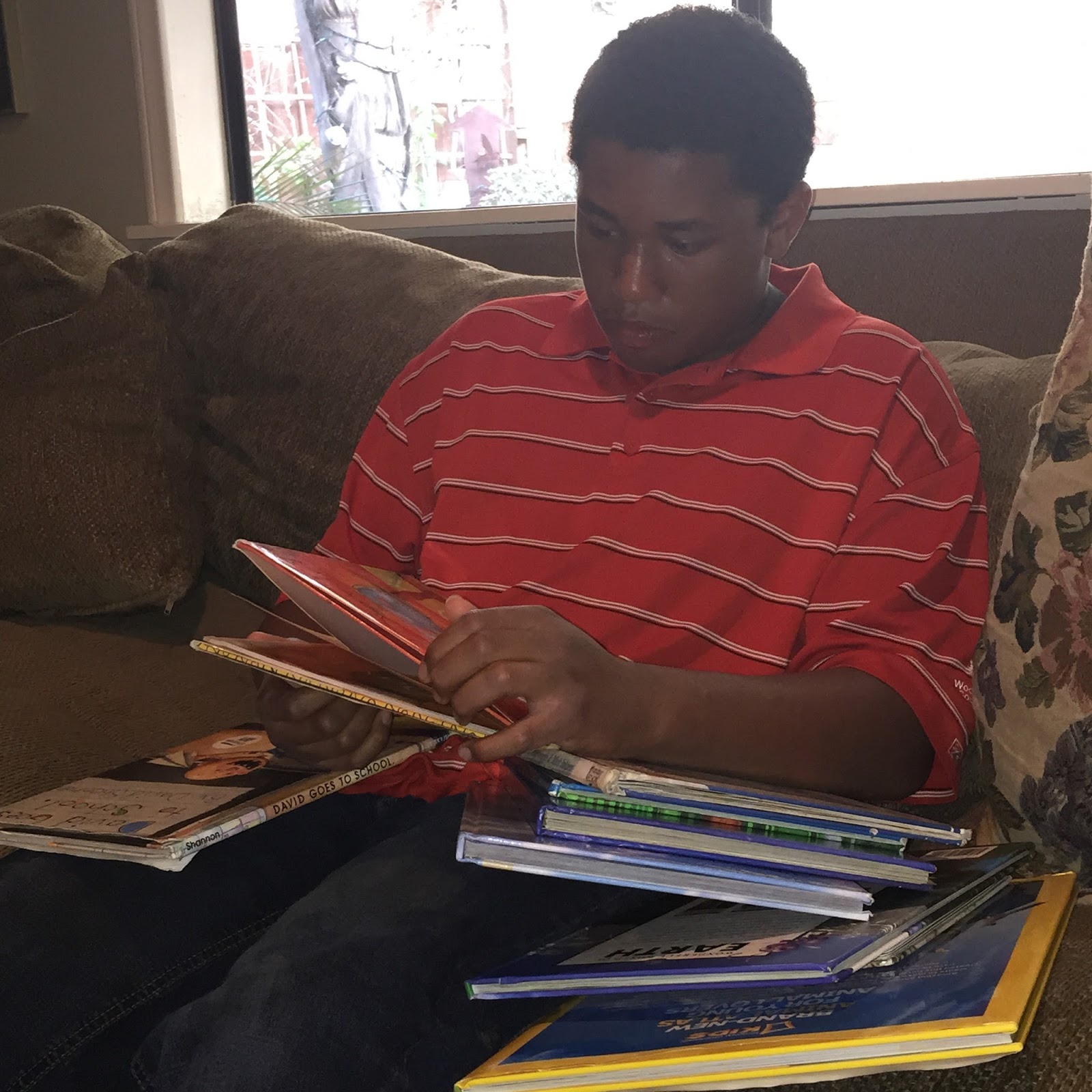
Nick loves Books....him just hanging our reading.

I'm happy to report that we've made progress and I wanted to share the process.   The first battle was getting the school to buy into the reality that no matter how long Nick spent in the SDC, no matter what he learned in the classroom setting, if he could not translate it directly into a vocation or show how it improved his independence, it was USELESS. A big ouch for educators who are well intended.  For example,  if Nick can do math in the workbooks in class, but he can't translate basic addition and subtraction to money, he can't independently  buy things from a bus pass, to groceries or clothing and he can't order and pay in a restaurant, so have to cross out one of the most basic skills required for independence.  
The second battle, was mediation because even once the school bought into the idea, they had no programs and the district rules said they could not create one. Nick was required under the rules of "Common Core" to remain in the classroom, take all the coursework so he could test and pass the standards.  What's funny about this in Nick's case is HE IS NOT ON THE DIPLOMA TRACK AND WON'T BE GETTING A DIPLOMA - BUT THEY STILL SAID HE HAD TO CONTINUE WITH THE COURSEWORK!!!  Fortunately  Federal law provided support, because the point of an IEP is to create the best educational program for each child. That said, the district finally agreed, and the school was given permission to create a real Individualized Education Program for Nick!   

Third, now that he could come out of the classroom, where to put him?  I had been building a relationship with school leadership for years, and had a team open to do the work needed to build a unique program inclusive of gen ed teachers willing to accept and support  Nick.  I know you're all really surprised to learn that all general education teachers are not open to having our kids in their classroom! LOL.   Then we had to build a program where he could spend  his day learning to use  what he's learned in class for the past 14 years in various settings, with a focus on vocational skills.  Here's his schedule now:
Nick Dressed Up To Sing in School
Choir Holiday Program! 
  • Homeroom (SDC)
  • PE (APE)
  • Language Arts (SDC)
  • General Ed Ceramics (where he does ceramics which he loves and helps the teacher with jobs)
  • Teachers Aid (TA) - For PE Coach 
  • General Ed Choir - Where he sings which is building new brain connections and he works on his social skills and functioning in a group.
  • Cafeteria Worker - Does various jobs as asked by supervisor 
  • Afterschool -  Farm Program 
The Forth Challenge is keeping it going and pushing vocation and independence at home. Our program started with one thing at a time and now when he comes home where he has chores, broken down into Daily (AM, Afterschool, Night time), Weekly and sometimes. 


  • Feed the dogs
  • Give the dogs water
  • Clean up after the dogs in the yard
  • Put clean silverware away
  • Take the trashcans out on trash pick up day
  • Organize cloths for the week
  • Empty Dishwasher
  • Gather his dirty laundry
  • Sort mom's filing alphabetically (new I'm tapping into this love for letters)
  • Shed papers 
  • Take out trash and recycle


He is learning how to follow instructions to cook. We use mix's so he can read the box (i.e. cookies, mac and cheese). We are starting with his favorites! Even a simple direction followed precisely with measuring is a big deal for us!  This is a place where he gets immediate reinforcement for using math! 


So that's what I have share your ideas.
.

Thursday, January 21, 2016

4 Major Companies Are Tackling The Autism Unemployment Epidemic

Learning 4 Major Companies Are Tackling The Autism Unemployment Rate Gave Me a Bit of Hope for Nick's future. 

Thank God we live in a country where private industry can focus on social good, and make an impact in our communities. Thank you Microsoft, Walgreens, Freddie Mac and SAP! 

We have a Walgreens down the street where Nick get's his prescriptions. They are like an extension of our family, always asking how he is doing, giving him compliments. This makes me wonder, maybe Nick can work there one day! 


For adults with Autism Spectrum Disorder, employment prospects are often disappointingly few and far between.According to a 2013 report published in the Journal of the American Academy of Child & Adolescent Psychiatry, the underemployment starts early. Just over 50 percent of young adults with ASD worked for pay outside the home within eight years after they finished high school. And when they did, the work was part-time and low-paying more often than not. Only about 20 percent of young adults with ASD worked full-time at either a current or a most-recent job, and their average pay was just $8.10 an hour.


Friday, January 15, 2016

Nick's First Weekend Away From Home...Ever! He's off to Camp :)

Oh my gosh, This is so exciting, such a massive step and I'm actually a bit anxious. Nick is going to camp and will be gone for 3 days! Three days! I know to most folks with a 17 year of it's not big deal, but he has never been away from me for three days in this life. He did stay overnight at a friends when he was in elementary school for one night...but that's it!

This will be the first time since he was born, 17 years ago, that my daughter and I have been together without him!

I'm so excited to spend some along time with her, and so excited that Nick get's sometime without us! This is big!


Tuesday, December 15, 2015

In Preparation of Nick's Transition IEP - Facts Make all the Difference

Nick's Transition IEP is coming up and my goal is to get his entire team committed to making sure he leaves school with skills that will increase his independence. He's been in school for a long time now, and my emphasis is NOT on teaching him more in the classroom, rather I am focused on helping him generalize the skills that he has learned, in the real world. 

Nick going to sing in the choir
Holiday program! 


At first the school would not build a custom IEP for him that meant him being out of the classroom, which we corrected in mediation. As a result he is only in his special day classroom for 1.5 periods. The remainder of the day is spent working in the the cafeteria, participating in Choir, being a teachers assistant for a PE coach, working on the school farm and participating in ceramics where he also assists the teacher. This plan insures that Nick has to interact with various people in various settings and is given the opportunity to apply what he has learned in the classroom to get a job, and feel good about himself. 


That said I thought it was important to give everyone involved in the process a full perspective, because if I've learned anything, I've learned that I can take nothing for granted. You might want to share this too. It's an easy overview and it makes the case for every kiddo who wants to be more independent. 


Autism Spectrum Disorder (ASD) is the fastest growing developmental disability in the

United States. Beginning in the late 1980’s, autism diagnoses began to skyrocket,

now affecting 1 in 68 children in the United States: a 1350% increase since 1993,

according to the Centers for Disease Control and Prevention. This makes ASD more

common than childhood cancer, juvenile diabetes and pediatric AIDS combined. An

estimated 1.5 million people in the U.S. and tens of millions worldwide are affected by

ASD. These children are now becoming young adults. About 50,000 young adults on the

autism spectrum turn 18 every year.


A Life Long Developmental Challenge

Addressing the epidemic of aging young adults with autism is a significant challenge for

families, our state, and our country. Autism is a life long developmental challenge. In the

coming decade as many as a half million children with autism will reach adulthood. Yet

very few residential and vocational development programs exist for them. The options

that do exist often have waiting lists of 8 to 10 years. Frequently, adults with autism are

placed in facilities or programs that are neither designed nor equipped to handle their

specific needs.

It's estimated that there will be a 300% increase in the number of young adults needing

residential services by 2020 with continued increases each year thereafter. These young

adults are aging out of the education system beginning this year.

No Pathway to Work

The growing demand for employment programs to support those with ASD has reached

a crisis level. Young adults with ASD in the U.S. workforce are scarce: 90% of people

with ASD are either unemployed or under-employed. Nearly seven years after graduating

from high school, 1 in 3 young adults with autism lack a college education, technical

training, or paid job experience. Only slightly more than half of young adults with autism

have ever worked for pay since leaving high school, according to a survey published in the

Journal of the American Academy of Child & Adolescent Psychiatry. Roughly 85% of

those with a moderate disability have worked and just 12% of the most severely disabled

have work experience. By comparison, young people with emotional disturbances,

learning disabilities, or impaired speech and language were roughly five times more likely

to have held a job. People with intellectual disabilities are twice as likely than those with

ASD to have been employed since high school.

Thursday, November 5, 2015

Governor Brown Stifles Bill That Would Provide Essential Funding Increase for Development Services

Seems our fight is NOT over. The future is not looking bright for our children as schools, states, politicians and insurance agencies realize the long term expense of caring for individuals with autism and other developmental disabilities. They are fighting to pass the expense on to someone else and stall efforts due to bipartisan inaction. This is a human issue and I'm sure Democrat, Republican, Tea Party and Independent party families are united when it comes to getting care for their loved ones. Sadly, any party being right won't be enough when it comes to budget. Families can't afford care on our own, so our only option to is be LOUD and let politicians know that Autism and developmental disabilities are not just an in topic to mention in speeches to get the attention of our families, but a real issue, and we demand their support!  

Write a letter, make a call or watch and see where the chips fall. I promise if we are not heard it will not be good. 
Donna


Bill would yield needed funding increase for developmental services
By The Editorial Board, LA Daily News

In August, when the Legislature’s special session on health care and developmental services was in still in session, we criticized Democratic leaders for not bringing forward good bills by their Republican colleagues.
Sen. Ed Hernandez, D-West Covina, talks with Senate President Kevin de Leon, D-Los Angeles, in this file photo. Hernandez is co-chair of the Legislature's special session conference committee on health and developmental services.(AP Photo/Rich Pedroncelli 
Now, with more than two months of hindsight under our belts, that obviously partisan inaction looks even worse.


If Senate Bill X2-4, by Republicans Jim Nielsen and Jeff Stone, had passed and been signed into law, it would be well on the way to producing the desperately needed 10 percent increase in funding for developmental services that the Lanterman Coalitionsought in the 2015-16 budget.
Instead, Gov. Jerry Brown stiffed the developmental community in the regular budget process and punted to a special session, which has produced nothing.
But it’s not too late. The special session is still officially “on,” with a Senate-Assembly conference committee formed to address the problem. Unfortunately, that committee has not held a single meeting.
If they continue to ignore the one bill that provides hope for additional developmental funding this fiscal year, Democratic leaders would doom nearly 300,000 of their most vulnerable constituents to another year of shrinking services. After seeing their resources from the state shrivel for two decades, that’s not what the developmental community deserves.
Quite the opposite. Californians with developmental disabilities and their loves ones and those who care for them deserve the immediate 10 percent funding hike along with a stable revenue scheme that will bring the system back to the minimum level of services promised in the 1969 Lanterman Act.
SBX2-4 would sweep unanticipated revenues — tax money above and beyond that budgeted for last fiscal year and this one — into funding for developmental services and Medi-Cal. It mandates that the director of the state Department of Finance, by Jan. 10, 2016, and again by May 14, determine excess revenue, subtract the amount that must go to schools under Proposition 98 and to the state’s rainy-day fund under Prop. 2, and direct the rest to developmental services until that 10 percent increase is funded, retroactive to July 1, 2015; any money left over after that would go to Medi-Cal providers.
The 2014-15 fiscal year ended with $732 million in unanticipated revenue, according to the state Department of Finance’s July finance bulletin. In the first three months of the fiscal year, the department reports, “Year-to-date revenues are $744 million above the expected $22.855 billion.”
That’s easily enough “extra” cash to give developmental services the 10 percent funding increase, which would cost about $350 million.
So what’s the problem?
The Legislature should simply get off the dime and pass SBX2-4.

Sen. Ed Hernandez, D-West Covina, failed to bring SBX2-4 forward to be heard as chairman of the special session’s Senate committee. Now we urge him and Assemblyman Rob Bonta, D-Oakland, co-chairs of the conference committee on health and developmental services, to convene their committee and to hear and debate SBX2-4 while the money is rolling in to state coffers.